Carmel Window Treatment Replacement Prices
Pricing ranges, what actually drives them, and what a written quote covers for Carmel homeowners.
Carmel whole-house jobs usually land between 18 and 30 openings, and the estate sections push that to 30 to 45. The count is the easy part. The harder part is that Carmel's largest housing group, the 1980s and 1990s two-stories, uses drywall returns on many windows, so usable depth shifts opening by opening inside a single house. That's why two quotes on the same street can look unrelated to each other.
- Faux Wood Blinds: $55-$300+ per window
- Wood Blinds: $70-$400+ per window
- Vertical Blinds: $60-$350+ per opening
- Aluminum Mini Blinds: $25-$140+ per window
- Roller Shades: $70-$450+ per window
- Solar Shades: $80-$520+ per window
- Cellular Shades: $70-$350+ per window
- Zebra Shades: $95-$400+ per window
- Roman Shades: $120-$600+ per window
- Woven Wood Shades: $110-$500+ per window
- Blackout Shades: $90-$550+ per window
- Plantation Shutters: $175-$800+ per window
- Cafe Shutters: $150-$550+ per window
- Motorized Shades: $300-$1,500+ per window installed
- Custom Drapery: $300-$4,000+ per window
- Valances & Top Treatments: $120-$700+ per window
- Exterior Solar Shades: $600-$3,500+ per opening
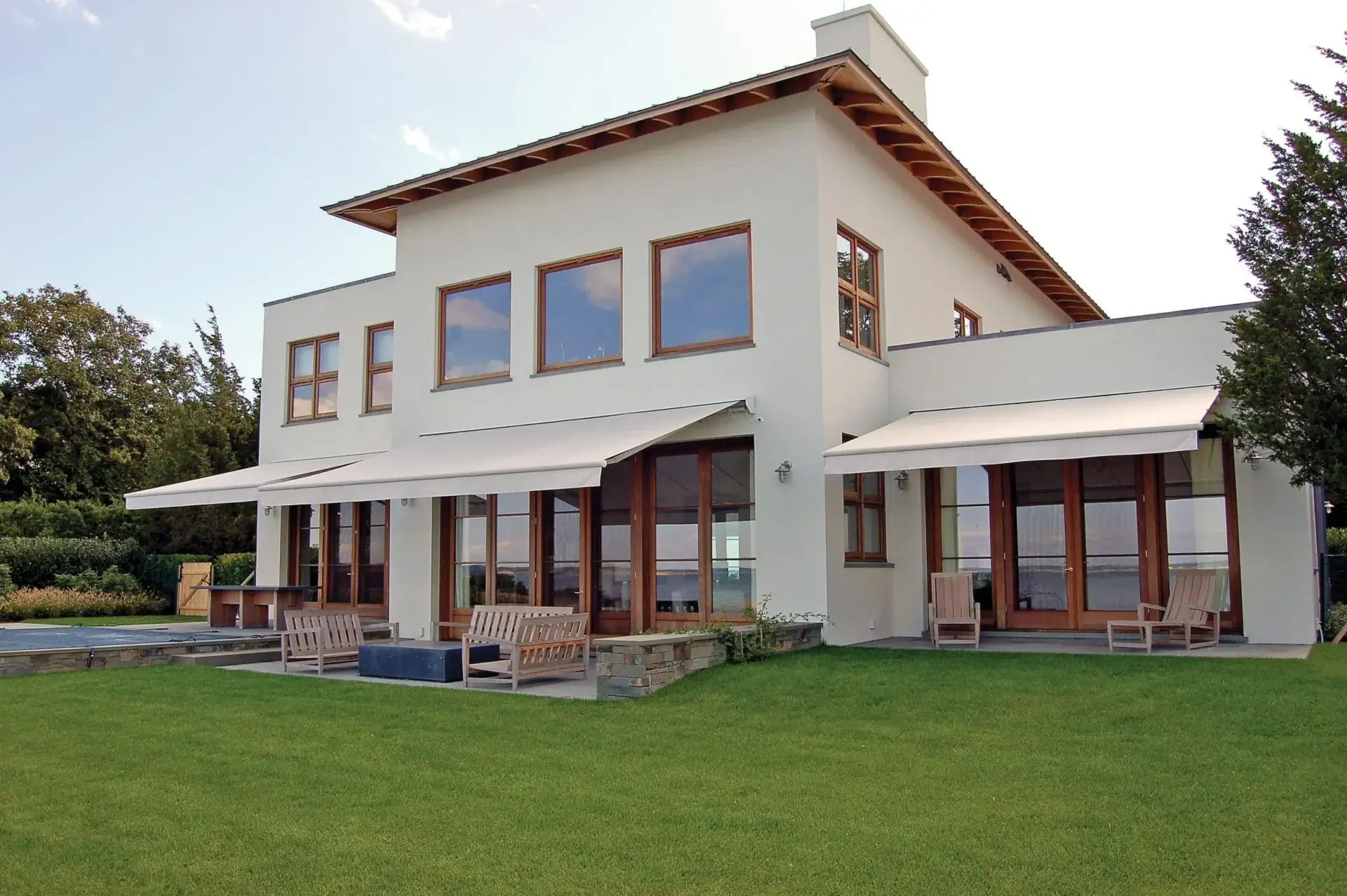
- Retractable Awnings: $1,000-$6,000+ installed
- Commercial Window Treatments: $12-$45 per square foot installed
- Skylight Shades: $300-$1,200+ per opening
- Sliding Glass Door Blinds: $250-$1,400+ per opening
- Panel Track Blinds: $200-$900+ per opening
- Sheer Shades: $180-$900+ per window
- Pleated Shades: $70-$350+ per window
- Bamboo Shades: $120-$600+ per window
- Dual Shades: $150-$800+ per window
- Top-Down Bottom-Up Shades: $150-$750+ per window
- Cordless Blinds: $70-$400+ per window
- Hardwood Shutters: $250-$900+ per window
- Composite Shutters: $175-$700+ per window
- Smart Home Shade Integration: $150-$600+ per hub or bridge
- Blind Repair & Restring: $45-$250+ per unit
- Shutter Repair: $60-$300+ per panel
- Motorization Retrofit: $200-$800+ per shade
- Outdoor Patio Shades: $400-$2,500+ per opening
- Office Window Treatments: Quoted per project
- Healthcare Window Treatments: Quoted per project
- Multifamily Window Treatments: Quoted per unit at volume
- Window treatments repair (most jobs): Quoted per unit once we have seen the part, not per house. A restring, a cord lock, a tilt gear, a ladder string or a battery wand is parts and labor with no fabrication behind it, so it does not carry the two to five week custom lead time.
- Free in-home measure and written quote
Typical Window Treatments Costs in Carmel
Pricing ranges below reflect typical Carmel market installations per window installed. Final quote depends on how many openings you are covering, their sizes, the product tier, whether any are out of square or a specialty shape, and whether you motorize.
Pricing is per window installed in the Carmel market as of 2026. The plus sign on upper numbers means your project may exceed the listed maximum based on inspection findings.
Factors That Affect Window Treatments Cost in Carmel
Two houses with the same number of windows can price very differently. Here is what actually moves the number.
How Many Openings, and How Big
The opening count is the largest single driver, and opening size is close behind, because headrail length and fabric yardage do not scale in a straight line. After that it is the product tier: faux wood blinds and basic roller shades sit at the bottom, cellular and solar fabrics in the middle, shutters and drapery at the top. Specialty shapes such as arches, angles, bays and sliding door widths cost more than their square footage suggests, because they are fabricated one at a time.
Opening Squareness and Depth
Openings that are out of square, casing too shallow to take an inside mount, plaster or masonry needing different anchors, and specialty shapes all add labor. That is what the three-point measure and the diagonal check are for, and it is why we would rather find it before you order than on install day. Hidden damage on aging window treatments is common and is scoped separately.
Access and Logistics
High openings, two-story great rooms, transoms and anything needing a lift cost more to install. Hardwired motorization adds licensed electrical time on top, which is why battery motors run roughly $100 to $300 a window less than hardwired.
Warranty Target
Warranty terms come from the manufacturer of the product installed and vary by brand and line. Many custom interior products carry limited lifetime coverage on the mechanism with shorter terms on fabric, motors and batteries. Motor and battery coverage is almost always shorter, so ask for the written warranty on the specific product quoted.
See What Each Fabric Does To The Light
Fabric choice moves the number about as much as size does, and it moves how the room feels a lot more. Pick one below and the window updates.
Openness factor is a measured fabric spec, so you can compare it line to line. The category names are not measured. One maker's room darkening can behave like another maker's light filtering, which is why the sample books come to the measure and get opened in the room they're going in, at the hour that room has the problem.
What Happens Between the Quote and the Install in Carmel
There is no claim and no adjuster in this trade. Window treatments are a planned purchase, so the money questions are different: what the deposit is, how long fabrication takes, and what is actually written down before anything gets ordered. Custom product generally runs two to five weeks from order to install depending on the product line and the finish, and longer on specialty shapes, motorized configurations and commercial submittals. If you are working toward a holiday, a move-in date or a listing, tell us the date at the measure and we will work backwards from it rather than quoting you a range.
Indiana has no statewide license for this trade, but the Indiana Home Improvement Contract Act at IC 24-5-11 does apply to residential work over $150, which is essentially every job we do. That means a written contract with your name and property address, our details, a reasonably detailed description of the work, start and completion dates, and the total price. Carmel Window Treatments writes the light gap, the mount type, the roll direction and the battery expectation into that scope too, because those are the four things people find out too late.
What Moves the Number on a Carmel House
Depth that changes room to room
About 40 percent of Carmel's housing was built from 1980 through 1999, and that stock is full of drywall-returned openings with no casing on many windows. The practical effect is that one bedroom takes a flush inside mount and the next one down the hall doesn't, in the same house, from the same builder. Every opening gets its own depth reading at the measure. It's also why a number quoted over the phone for a Carmel house is close to meaningless.
Half-round transoms over the entry
Half-round and elliptical transoms over the front door and over the foyer window are close to standard on Carmel builder plans from 1995 to 2010, and two-story great room walls came with them. A curved head can't take an off-the-shelf size, so it either gets a shaped insert cut from a site template or gets left alone with a square treatment set above it. Both are legitimate answers and they price nowhere near each other, so decide that one early.
Estate sections and the 45-opening house
Bridlebourne, Crooked Stick West and Jackson's Grant on Williams Creek sit at the top of the Carmel market, where a house can carry 30 to 45 openings. At that count the small per-window decisions stack up fast, and the gap between a mid-range cellular and a wood shutter across forty openings is the single largest choice in the job. These are also the houses most likely to have a room with glass on three sides.
Village of WestClay's revival fronts
WestClay was built in the 2000s as historic revival, so you get Federal, Greek Revival, Italianate and Gothic detailing on new construction. In window terms that means tall narrow double-hungs, divided lites, and transoms sized to the style rather than to a catalog. Those proportions rule out a lot of standard sizes and push toward custom widths. The upside is that the openings themselves are modern, with proper jamb depth and applied casing to mount into.
Three Carmel houses, scoped
Twenty-six is a normal Carmel middle. Four to six of those openings are in the great room, including whatever sits above the first floor line, and the foyer usually adds a half-round head. Bedrooms and baths are ordinary sizes. Per opening, custom work carries a national range of $250 to $2,600 measured and installed, and the spread inside one house like this is wide, because the great room wall and the back bedroom aren't the same product.
These are the low-count Carmel jobs, often in the mid-teens, with a split plan that puts three or four openings on each level. Casing is usually there and usable, though older jambs can be out of plumb enough to matter on a wide unit. There's no tall glass to reach and no lift day. The real decision is whether to match the original trim with a wood-look product or go a different direction while the house is being updated.
At the estate end this becomes a room-by-room plan rather than one order. Public rooms take the money while secondary bedrooms take a simpler product. The two-story spaces need lift access on install day. Motors come up often at this count because some units are genuinely out of reach, and a battery motor prices $100 to $300 per window under a hardwired one nationally, with no walls opened in a finished house.
Carmel prices spread wider than any list can show, because a 1988 two-story and a 2019 Jackson's Grant house are different jobs in the same city. Any per-window number you read here is a national range, and your own quote comes out of the measure.
What Matters at the Window in Carmel
What our crew has learned working in Carmel homes.
About Carmel Homes
Carmel's median house dates to 1995. Build era shares on the parcel record run pre-1940 0.7%, 1940-1979 23.7%, 1980-1999 40.3%, 2000-2019 30.7%, 2020+ 4.6%. Median home value is $486,800. Two different worlds. The 1980s-90s majority is dominated by drywall returned openings with no casing at all on many windows, so usable inside mount depth varies opening to opening within one house and must be measured, not assumed. The 2000+ stock generally has proper jamb depth and applied casing. The 216 pre-1940 houses and the Home Place stock have narrow flat casing and shallow, out of plumb jambs. 1980s-90s traditional two story (brick front, vinyl sided sides and rear); 1970s ranch and tri level in Brookshire and the Cool Creek subdivisions; 1990s-2000s builder Georgian and transitional with two story entry; 2000s New Urbanist historic revival - Federal, Greek Revival, Italianate, Gothic. Typical opening count: 18-30 openings for the dominant 1985-2005 two story, rising to 30-45 in the estate sections.
Where We Work in Carmel
We cover homeowners across Carmel near Carmel Arts and Design District in Old Town, The Palladium at the Center for the Performing Arts, Carmel City Center, Monon Greenway and Midtown Plaza, Brookshire Golf Club (the city's only public course), Crooked Stick Golf Club.
Surrounding Areas We Serve
Our crew also covers Village of WestClay, Brookshire, Cool Creek North, Home Place, Jackson's Grant on Williams Creek, Springmill Ponds, Claridge Farm, Crooked Stick West, Bridlebourne, Smokey Ridge.
Recent Weather Patterns
Central Indiana sits in IECC climate zone 5A, which means a real cooling load and a real heating load on the same window. NOAA's 1991-2020 normals for Indianapolis put the July average high at 85.2F, the January average high at 36.1F and the January average low at 20.9F, with the muggy season running May 25 to September 22. Carmel is the most consistently shaded of the five towns studied, and the reason is in the parcel data: 24.4% of its single family houses predate 1980, versus 3.0% in Fishers and 4.2% in Westfield.
What Our Crew Sees in Carmel
Two story great room and foyer window walls are common in the 1990s and 2000s stock. Half round and elliptical transoms over front entries and over the foyer window are near standard on 1995-2010 builder elevations. Active new construction includes Jackson's Grant on Williams Creek, Jackson's Grant Village, Village of WestClay, Bedford Falls of Carmel, Estates at Towne Meadow.
Who Actually Turns Up in Carmel
The same people measure, order and install. Customers name them in reviews, which is the point: you are not getting a subcontractor you have never heard of.









What We Are Running in Carmel Right Now
Both offers apply to work quoted and ordered while they are posted here. Ask about them at the in-home measure and we will put the discount on the written quote before you decide anything.
$500 Off Your First Exterior Screen, Plus a Free Motorization Upgrade
Take $500 off your first exterior screen and we will add the motorization upgrade at no charge. Exterior screens stop solar heat outside the glass, which is the only place you can stop it before it is already in the room, and a motor is the difference between using one and forgetting it.
Applies to a first exterior screen. Ask at the measure so the discount is on the written quote before you order. Motorized product runs on batteries that need replacing, about a year on Hunter Douglas PowerView.
Ask about this offerFree Motorization Upgrade on Select Interior Shades
Pick from the qualifying interior shade lines and the motorization upgrade is free. It is worth most on the openings you would otherwise leave alone: tall great room glass, anything above a stair, and the west windows nobody remembers to close by four.
Select interior shade lines only. We will tell you at the measure which of your openings qualify. Batteries are a real running cost and are not included.
Ask about this offerPayment Options That Work for You
Your Carmel Window Treatments project lead will walk you through every financing option during the assessment. Terms in writing, no pressure, no surprise charges.
Start the work now and begin paying later. On a whole-house order this is how people phase a large job without phasing the install.
- Payments deferred for a promotional period
- Rate and period set by the lender
- Quoted price held for the order
Divide the project cost into equal monthly payments across a fixed promotional period, so the budget is predictable from day one.
- Equal monthly payments
- Fixed promotional period
- Simple, predictable budgeting
Spread a larger window treatment project across a longer term with fixed equal payments, for homeowners who want the lowest monthly amount.
- Extended terms available
- Fixed equal payments
- Suited to larger window treatment projects
Financing is arranged through third party lenders and is subject to credit approval. Rates, terms, and promotional periods are set by the lender and disclosed to you in writing before you sign. Ask your project lead which programs are open right now.
Window Treatment Cost FAQ for Carmel
Cost-related questions we hear most often from Carmel homeowners, designers, and property managers.
Book a Free In-Home Measure
We will measure every opening, show you fabric in your own light, and put the scope and the lead time in writing before anything is ordered. No obligation. We reply to Carmel enquiries during business hours.