Wood Blinds

Carmel Wood Blinds

Real basswood, in the rooms that can keep it flat

Call (317) 863-9966Get Free Quote
Quick Answer

What follows is what we'd tell you in person about this service, including which rooms it belongs in and which ones it doesn't. That second list is shorter but it saves more money.

  • Service: Wood Blinds for Carmel homeowners
  • Service area: Carmel, IN and surrounding areas
  • For a new order, plan on a measure appointment, then two to five weeks of fabrication, then an install visit. For a broken tilt gear or a dead battery, it's usually a single short visit and no waiting.
  • Insured and bonded
  • Serving Carmel, IN since 2008
Wood Blinds Services

Expert Wood Blinds for Carmel Homes

Hardwood blinds belong in the rooms of a Carmel house that stay conditioned all year. Basswood takes a stain the way a painted composite never will, and in a 1990s house with stained trim it is often the only product that can match what is already on the walls. The catch is that wood is a moving material in this climate. We will specify it happily in a living room, a study or a formal dining room, and we will argue with you about a laundry room.

Matching is the real work. Carmel's 1980 to 1999 stock, the largest group in the city at 11,864 houses, carries a lot of stained oak and stained poplar trim that has ambered for thirty years. A stain chip that looks right in a sample book under showroom light rarely looks right against that trim at four in the afternoon, so we bring the chips to the room and hold them against the casing you actually have. On painted trim the question flips to sheen and undertone rather than color name.

Wood blinds are heavier than faux wood at the same size, which changes what a wide opening can carry. On a mulled bank we split the run and share a valance rather than hang one long headrail that will sag and go stiff at the tilt. The parts that fail are predictable: ladder strings wear where the sun hits, the tilt gear strips if somebody forces a stuck slat, and both are repairable without touching the rest of the blind.

When to Call

Signs You Need Wood Blinds

If you notice any of these in your Carmel home, it is worth booking a measure. None of it is urgent, and none of it fixes itself either.

Stained trim in the study has nothing coordinating on the windows

Existing wood blinds have opened at the joints near a vent

You want a warmer material than a white composite slat

The 1994 great room needs one stain across four openings

A tilt gear grinds and the slats stop halfway

Sun has bleached the slats on one elevation only

You are matching new blinds to thirty year old ambered casing

The dining room reads cold with painted blinds in it

Our Process

How Carmel Window Treatments Handles Wood Blinds

Every job follows the same six-step process. Transparent, thorough, and done right the first time.

1

Walk the rooms first

Before anything is measured we sort the house into rooms that stay conditioned and rooms that swing. Kitchens, baths, laundries and unconditioned sunrooms come off the hardwood list at that point, which sometimes shortens the order and always shortens the warranty conversation later. What stays on the list gets measured for wood.

2

Hold the stain to the trim

Stain chips get held against your own casing in your own light, at the time of day the room is used. Thirty years of ambering on 1990s oak means the chip that matches under a showroom lamp can read orange at home. Where the trim is painted, we compare undertone and sheen instead, because a cool white blind against a warm white casing reads as a mistake.

3

Three point measure each opening

Widths and heights at three points, a diagonal on each opening, and mounting depth confirmed at the stop against the headrail depth of the chosen line. On a settled opening the difference between the narrowest and widest reading is the number that decides whether an inside mount is honest, and you get told that number rather than a verdict.

4

Plan the wide runs

Anything wide enough to sag gets split into two or three units under a continuous valance, with the divisions placed on the mullion lines of the opening so they look deliberate. Wood is heavier than composite at the same size, so the split point comes earlier. Center support brackets are specified where a single unit is still the right call.

5

Order one stain run

Stained wood varies between production runs the way fabric varies between dye lots, and the difference shows most on adjacent openings. The whole house goes on one order so the stain comes off one run. If rooms are being phased, we note which openings sit in the same sightline so a later batch does not land next to an original.

6

Install and dress the slats

Brackets into solid material, headrail leveled against a plumb line rather than against a settled opening, valance and returns fitted last. Then the slats get run through full tilt and full lift with you watching, so anything binding is caught while we are still in the room rather than reported a week later.

Real Project Photos

Wood Blinds in Carmel

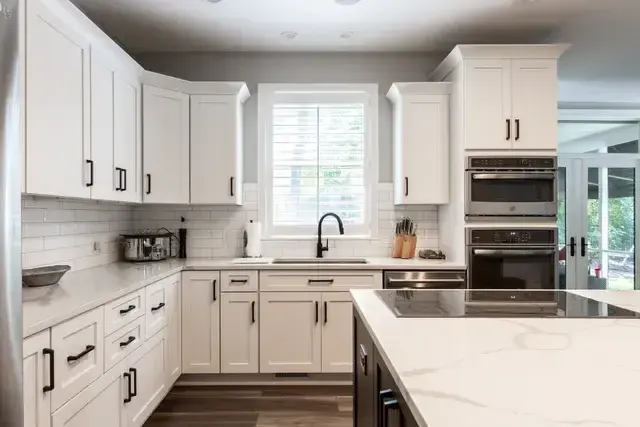
Photographs from real wood blinds jobs completed by our crew in Carmel and surrounding areas.
Custom shades measured and installed in CarmelPlantation shutters fitted to a Carmel windowCellular shades in a Carmel living room
Scope of Work

What Wood Blinds Includes

Every Carmel job is documented item by item. Here is what the crew covers.

Room-by-room check that every opening stays conditioned all year before wood goes onto the order

Wet rooms ruled out in writing, because a bath or a window over a sink is a faux wood job

Three widths and three heights per opening, plus a diagonal check for square

Mounting depth measured so the headrail sits fully inside the opening where an inside mount is wanted

Basswood specified as the working standard, with heavier species used only where the grain has to carry a room

Slat size chosen against the opening height and the weight of the existing casing

Wider single spans priced without a support bracket, since wood weighs less per foot than composite does

Stain or paint matched from a physical sample held against your actual trim in your actual light

Grain variation and color drift across a stained order explained before anything gets signed

Cloth tape ladders selected where a woven band suits the room and hides the route holes

Routeless construction offered where a line of lit holes would bother you at night

Valance profile and return depth chosen to sit correctly against existing millwork

Wand tilt set as the default, with cord tilt only where a wand fouls a handle or a return

Cordless lift specified in bedrooms, stairwells and any room children use

Products specified to conform to ANSI/WCMA A100.1-2022 for cord access

Light gap per side disclosed at the measure and carried onto the paperwork

Written contract with scope, dates and total price, as IC 24-5-11 requires on residential work over $150

Slats leveled and both full tilt travel and full lift travel tested at every window on install day

Pricing

What Wood Blinds Cost in Carmel

Published national figures for the category put stock blinds and shades near $60 to $600 a window, with custom-fabricated product running roughly $250 to $2,600. Those are national ranges and they aren't a quote for a house in Carmel. Real wood sits above faux wood in that band and it should, because you're paying for a milled hardwood slat and a finish that has to look right next to your existing trim. Size drives the number first. After that it's the finish: a stock stain costs less than a color matched to millwork, and a matched finish sometimes means a sample run before production. Cloth tapes, a deco valance and routeless slats each add. Carmel Window Treatments prices from measured openings in Hamilton County, never from an average.

By Product

How Wood Blinds Differ by Product

Every product in this trade behaves differently in a room. Here is what that means for this work.

2 inch basswood slat: Our working standard in real wood. Basswood is light for its stiffness, which is exactly what you want in a lift mechanism, and the 2 inch slat suits the openings and the casing we find in most central Indiana houses.

2 1/2 inch basswood slat: The same species with a wider face, so fewer slats cross the opening and the view out improves when they're tilted open. It suits taller windows and rooms with substantial casing, where a narrow slat starts to look busy against the trim.

Heavier hardwood species: Some lines offer denser woods that take a stain with more figure than basswood shows. They cost more and they weigh more, so we reserve them for a room where the blind is meant to be looked at rather than looked through.

Stained finish: A transparent finish that lets grain read through, which is the reason to buy wood at all. Expect variation from slat to slat, because that's the wood talking. We hold a physical sample against your trim before committing anything to an order.

Painted finish: An opaque finish in white or an off-white, which gives you wood's light weight and a face that reads as painted millwork. It's the right call when the blind should disappear into the trim instead of standing apart from it.

Custom color match: The factory matches a finish to a sample you supply, usually a piece of your casing or a stair part. It adds cost and time, sometimes a sample run before production, and it's the only honest way to hit an existing stain.

Cloth tape ladders: A woven tape running down the face of the blind that covers the route holes and adds a color band. On a stained wood blind it's a strong design move, and it narrows the view a little wherever a tape crosses the slats.

Routeless wood slats: The lift cord sits in a notch at the back edge instead of a punched hole, so a closed blind has no line of bright dots across it. In a bedroom with a streetlight outside, that's the difference people actually notice.

Crown or deco valance: A shaped valance with a deeper face than the standard flat one, meant to read as trim rather than as a cover for hardware. Choose it where the casing is heavy enough that a plain valance would look thin against it.

Cordless lift: A constant-force spring in the headrail with no lift cord on the blind at all. Wood's lower weight makes cordless feel better here than it does on composite, and it's what we put in bedrooms and anywhere along a stairwell.

Common Questions

Wood Blinds FAQ

Questions we hear most often from Carmel homeowners considering wood blinds.

Bathrooms, kitchens, laundry rooms and unconditioned sunrooms. This area runs a muggy season of roughly four months followed by a dry heated winter, and hardwood responds to that cycle with dimensional movement: slats cup, stiles bow, joints open and painted finishes check at the joint first. A room with shower steam or cooking moisture accelerates all of it. We would rather put composite or poly in those rooms and hardwood everywhere else than sell you one material for the whole house and warranty a problem we could see coming. There is a middle path worth knowing about: composite slats with a printed grain and a real wood valance in the same room, which keeps the warmth at eye level and the durability where the moisture is.
Usually close, rarely exact, and the honest version matters. Carmel's largest housing group, the 11,864 houses built from 1980 to 1999, is full of stained oak and poplar that has ambered over three decades, and no factory stain chip is mixed to match a thirty year old finish. We bring the chips to your casing and look at them in the room's own light rather than under a showroom lamp. Where an exact match is not achievable, a deliberate contrast usually looks better than a near miss, and we will show you both against the trim. Finish sheen matters as much as color here. A satin blind against a semi gloss casing reads as a mismatch even when the color is dead on, so we compare sheen deliberately rather than by accident.
Beyond a certain width, yes. Hardwood weighs more than composite at the same slat size, so a single headrail across a wide great room opening sags in the middle and the tilt gets stiff toward the far end. On the mulled banks common in Carmel's 1990s great rooms we split the run into units that line up with the mullions and sit under one continuous valance, so it reads as one treatment. Where a single unit still makes sense, a center support bracket carries the middle and keeps the headrail straight. There is also a practical limit set by the headrail rather than the slats, since a longer headrail carries more mechanism and any twist in it shows up as slats that will not close evenly across the run.
View and stack. A wider slat shows more glass when open and stacks into a deeper bundle at the top when raised, which matters on a shorter opening where the stack eats visible glass. A narrower slat closes tighter and suits smaller openings. In Carmel's 1990s stock, where a lot of front elevations carry tall narrow units flanking a wider center window, we often run the same slat width across the group so the closed lines match rather than optimizing each opening separately. Stack depth is the other consequence, because a raised wood blind sits proud of the opening and, on a shallow inside mount, can end up projecting past the casing in a way a photograph never warns you about.
They lighten on the elevation that takes the most sun, and the effect is uneven because one face of each slat sees more light than the other. National Fenestration Rating Council guidance attributes roughly 40 to 60% of fading damage to ultraviolet, with visible light and heat making up the balance, so any shading device slows fade rather than preventing it. If a west room matters to you aesthetically, the practical answer is a solar shade working with the blind, or accepting that the west room will age differently from the north one. Rotating the slats to close upward rather than downward on the sun side puts the exposed face in shadow, which will not stop fading but does slow the visible difference between the two faces.
Yes, with hold down brackets, and the detail is worth getting right. On a door that swings, the blind needs hold downs at the bottom rail so the slats do not swing and knock every time somebody uses it, and the mount has to clear the handle and any lock hardware. On a patio slider, wood blinds are the wrong tool and a vertical or a panel product is the right one. We check the swing and the handle clearance at the measure rather than discovering it on install day. On a French door the same rule applies with less margin, since the mount has to clear the handle and still leave the door able to close against the frame without the bottom rail catching.
A dry cloth or a vacuum brush along the slat, tilted closed one way and then the other. What hardwood does not want is a wet wipe, because moisture sitting on the finish is what opens the joints over time. This is the same reason a kitchen window over a hob is a poor candidate for hardwood in the first place. If a room genuinely needs to be wiped down rather than dusted, that room should have had composite or poly in it, and we will say so before you order. Dust also settles on the upper face of an open slat, which is why blinds that live closed in a formal room stay clean for years while a kitchen blind needs attention every few months.
Frequently, yes. Ladder strings, lift cords, tilt gears, wands and cord locks are all serviceable parts, and none of that carries a fabrication lead time, so it moves quickly. The limit is discontinued product. If the manufacturer has stopped making that headrail or that slat profile, there is nothing to fit and the sensible move is to replace the unit or the room rather than chase a part. Bring us a photograph of the headrail end cap and we can usually tell you which side of that line you are on. On a small blind the labor can exceed the cost of a new unit, and we would rather say so than bill you for the visit.
Because wood answers moisture by moving, and a bathroom gives it plenty to answer. A slat that takes on humidity swells slightly across its width, then gives that moisture back when the room dries out, and after enough cycles it doesn't come back straight. You get cupping along the slat and a blind that stops closing evenly. Faux wood has no fiber left to swell, so it does that job instead. In a white blind, from across the room, you'd have a hard time telling which is which anyway.
It runs it through two opposite conditions. The muggy stretch here goes from late May into late September, so a wood slat spends about four months taking on humidity. Then the heat comes on, indoor air gets dry, and the same slat gives that moisture back over a heated winter. In a conditioned room that cycle is mild and the blind is fine for years. In a room that swings, a sunroom or an unconditioned porch, it's the cycle that eventually takes a slat out of flat.
For most of what we hang, yes. Basswood is stable, mills cleanly, and it's light for its stiffness, which matters more than people expect. Weight is what a lift mechanism fights, and a lighter slat means a wider blind can work as one unit and a cordless lift feels smoother in the hand. Denser species exist and they show more figure under a stain, but they cost more and they add weight. We use them where a room is really about the look of the wood.
Usually close, sometimes exactly, and never from a screen. We bring physical samples and hold them against your casing in the light that room actually gets, because a stain that looks right under a showroom lamp can read orange at four in the afternoon. If nothing in the standard range lands, a custom color match sends a sample of your trim to the factory. That adds cost and time. It's also the only method that gets you there, so we'd rather quote it honestly up front.
Because it's wood. Grain runs differently through each piece, stain sits into open grain more heavily than into tight grain, and a slat cut from one part of a board takes color a little differently from its neighbor. On a stained blind that variation is the product working as intended, not a fault. If you want a face with no variation at all, a painted wood blind or a composite slat is the honest way to get it, and we'll say so before you order.
Wood is fine there as long as the room stays conditioned, which a living room does. What you should know is that a stained wood slat sitting in direct afternoon sun will lighten over years, and it lightens on the sun side more than the shaded side, so a wide window can end up reading unevenly. NFRC puts UV at roughly 40 to 60 percent of fading damage. Tilting the slats up bounces the direct sun toward the ceiling and slows the change. It doesn't halt it.
Wider than the same blind in composite, which is one of the practical arguments for wood. Every manufacturer publishes a maximum width and a maximum square footage, and those limits are really weight limits. Basswood weighs less per running foot than a faux wood slat of the same size, so a span that would want a center support bracket or a two-on-one headrail in composite can often stay a single unit in wood. We check the actual numbers against your measured opening before ordering.
They're woven tapes that run vertically down the face of the blind, covering the route holes and carrying a color band. Mechanically almost nothing changes, since the ladder still holds the slats and the lift still runs the same way. What changes is the look, quite a lot, and the view, slightly, because each tape sits across the slats and blocks a narrow strip when they're open. Frayed tapes on an old blind are one of the common reasons people replace an otherwise working unit.
On a tall window the wider slat usually wins. Fewer slats cross the opening, the face reads calmer, and the view between open slats is better, which matters more the more window there is. The 2 1/2 inch slat also suits heavier casing, and older houses in Carmel often have casing worth respecting. Where we go back to 2 inch is a short window, a transom or a room with delicate trim, since a wide slat there swamps the opening it's sitting in.
They slow it, and that's the accurate word. NFRC attributes roughly 40 to 60 percent of fading damage to UV, with the rest coming from visible light and heat, so no window covering ends the problem outright. A closed wood blind is an opaque layer, which does more than a sheer fabric, and tilting the slats upward on a sunny afternoon keeps direct sun off a hardwood floor while the room stays usable. That's a real reduction in exposure rather than an end to it.
You can order more, and you should expect a small difference. Stain lots vary, wood varies, and a blind built next year comes from different boards than the ones hanging now. Across a hallway nobody sees it. On two windows in the same wall it's obvious. The practical answer is to order a room complete rather than half of it, even where a window seems low priority. We write the exact finish name onto your paperwork so a later order at least starts from the right reference.
Dry first, always. Close the slats one direction, run a dry microfiber cloth or a vacuum brush across the face, then close them the other way and repeat. For a mark that won't dust off, use a barely damp cloth and dry it immediately. Don't soak a slat, don't use a spray cleaner across the whole blind, and never put a wood blind in water the way people sometimes do with vinyl. Cloth tapes want a soft brush rather than anything wet.
In a bedroom or along a stairwell, yes. There's no lift cord on the product at all, which is the direction the ANSI/WCMA A100.1-2022 work on cord access points, and inner-cord non-compliance is treated as a substantial product hazard under 16 CFR 1120.3. Beyond that, a cordless wood blind is simply nicer to use every day, and wood's lighter weight makes the mechanism feel smoother than it does on a heavy composite unit. On very wide blinds we still talk through whether motorization is the better answer.
Custom fabrication runs two to five weeks in this trade, and stained wood tends toward the longer end because finishing is a separate step at the factory. A custom color match adds more, sometimes a sample run before production even starts. None of that is a delay. It's a factory milling and finishing slats to sizes taken in your house. You'll get the window in writing with scope, dates and total price, which the Indiana Home Improvement Contract Act requires on residential work over $150.
Free In-Home Measure

Schedule Your Free In-Home Measure in Carmel

Contact Information

Reach Us Directly

Our team prioritizes scheduled measures and service calls, and books in-home measures during business hours.

Office
1417 Commerce Avenue, Indianapolis, IN 46201
Hours
Mon-Fri 8a-6p
Service Area
Carmel, IN and Surrounding Areas

Ready to Book Your Measure?

Call us to set up an in-home measure, or to ask about a treatment that has stopped working. We will talk it through on the phone first.

Service area

Serving Carmel and the surrounding area

Call NowGet Quote