Carmel Zebra Shades From Carmel Window Treatments
Two positions, one shade, one set of brackets
Answers here cover the whole lifecycle: measuring, ordering, fabrication, installation, care and service. A custom window covering is a long-term purchase and the later stages deserve as much attention as the first.
- Service: Zebra Shades for Carmel homeowners
- Service area: Carmel, IN and surrounding areas Nothing in this trade is an urgent call-out, so here's the real timeline. Measures get scheduled promptly at a time that suits you. Custom fabrication then runs roughly two to five weeks. Installation is a morning or a day.
- Insured and bonded
- Serving Carmel, IN since 2008
Expert Zebra Shades for Carmel Homes
Zebra shades, also sold as dual or banded shades, are a roller with alternating sheer and opaque bands on one length of fabric. Roll the bands into alignment and you get a sheer view with glare cut. Offset them and the opaque bands close together and the room goes private. It is one treatment doing two jobs on one bracket, which is why it turns up so often on the openings where a household wants a view at noon and cover in the evening.
In Carmel the common application is a room that faces something worth seeing but also something that can see back. That includes the Monon corridor and the Midtown blocks, front rooms on a village street with a shallow setback, and rear elevations looking across a fairway where foot traffic passes at eye level. A zebra shade lets you keep the outlook during the day without hanging two separate treatments over one window, which on a Carmel sized opening is a real saving in both cost and visual weight.
The honest limitations. A zebra shade in its privacy position is not a blackout treatment, because light passes at the band edges and, on an inside mount, down the sides. The alignment between the two fabric layers is what eventually goes rather than the clutch, and a shade that has lost alignment shows a shadow line across the window. And like any roller, tube diameter is set by width and drop, so a wide great room opening usually wants two shades rather than one.
Signs You Need Zebra Shades
If you notice any of these in your Carmel home, it is worth booking a measure. None of it is urgent, and none of it fixes itself either.
You want the view at midday and privacy after dark
Two treatments on one window feels like too much
Front rooms sit close to a sidewalk with foot traffic
Sheers cut nothing and blinds block the outlook entirely
The bands on an existing shade no longer line up
A rear room looks onto a path people walk along
You need one product to handle both glare and privacy
Modern rooms need something lighter than a wood blind
How Carmel Window Treatments Handles Zebra Shades
Every job follows the same six-step process. Transparent, thorough, and done right the first time.
Test both positions in place
We hold a sample at the window and show you what the aligned position and the offset position actually look like in that room at that hour. People buy this product from a photograph and are sometimes surprised by how much passes through the sheer bands, so seeing it against your own view first prevents a disappointment that no adjustment will fix later.
Measure and check the diagonal
Three widths, three heights and a diagonal per opening, plus the mounting depth at the stop. Banded fabric is less forgiving of an out of square opening than a plain roller, because a shade sitting slightly off level shows the band lines running out of parallel with the head trim, which the eye catches immediately.
Choose band scale and fabric tier
Band height changes how the shade reads on a given window, and a scale that suits a tall foyer opening looks heavy on a short kitchen window. The fabric tier decides the privacy position: light filtering, room darkening and blackout bands each behave differently after dark. We pick both against the room rather than the sample book.
Set roll direction and clearance
The tube can roll regular or reverse, and the choice has to clear any handle, crank or lock while keeping the fabric close enough to the glass to limit the gap. On a door or a window with hardware standing proud, this is decided at the measure and marked per opening rather than left to the installer to work out on the day.
Plan wide openings as pairs
Beyond a certain width a single tube deflects and the bands stop tracking parallel, which is more visible on a banded fabric than on a plain one. On the wide openings common in Carmel great rooms we split the run into two shades under a shared fascia, aligning the split with an existing mullion so the division reads as part of the window.
Install, align and demonstrate
Brackets set level to each other, the shade run through full travel, and the two positions demonstrated with you in the room so you can see where the alignment point falls. Then we show you how to bring the bands back into alignment if the shade is dropped quickly, because that is the adjustment owners most often need.
Zebra Shades in Carmel
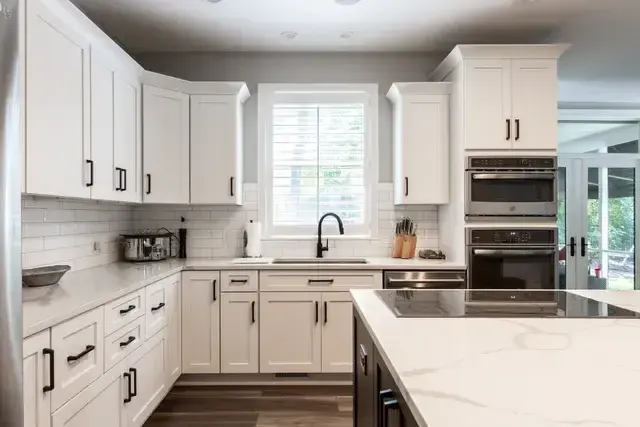
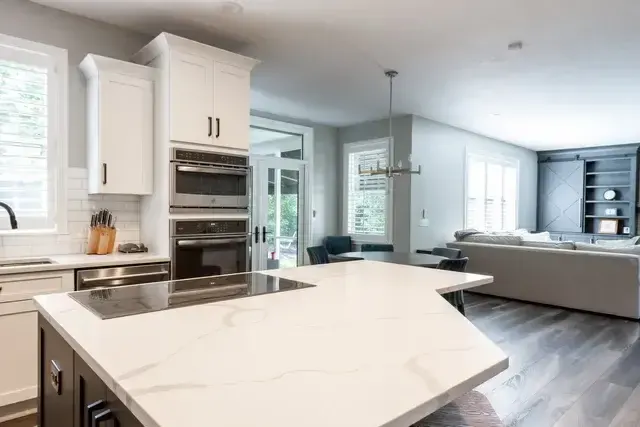
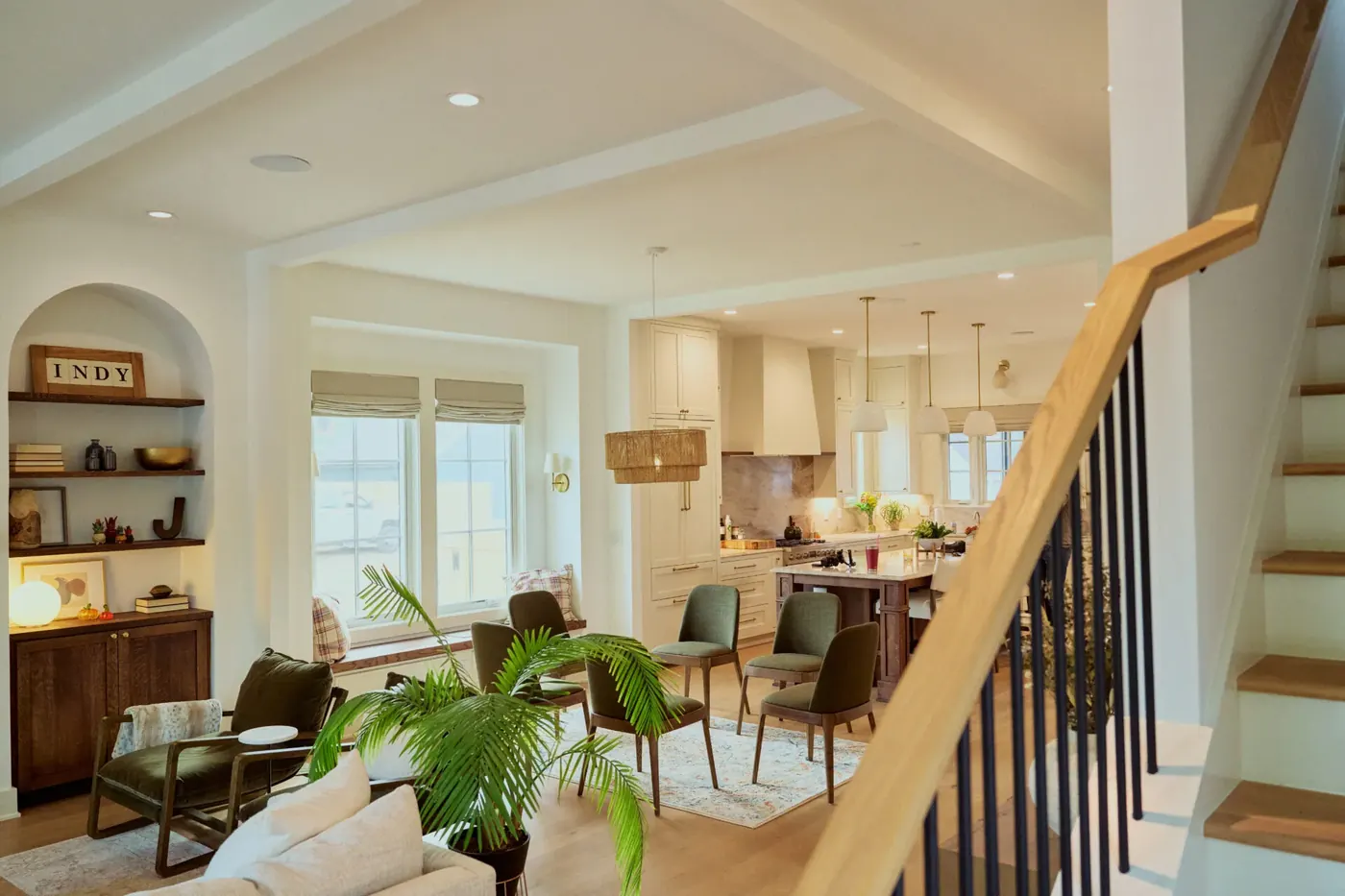
Photographs from real zebra shades jobs completed by our crew in Carmel and surrounding areas.
What Zebra Shades Includes
Every Carmel job is documented item by item. Here is what the crew covers.
Band alignment shown to you on a working sample before anything is ordered, because that's the entire mechanism
Band height chosen against the opening so the stripes stay in proportion on a short window
Sheer and solid band opacity picked as a pair, light filtering, room darkening or a blackout-backed tier
Cassette specified as the default, since a bare double-layer roll reads unfinished at the top of an opening
Three widths and three heights at every opening, with the diagonal checked for square
Mounting depth measured for the cassette, which needs more room than a plain roller bracket does
Tube and fabric weight matched, because a zebra carries roughly twice the fabric of a single-layer roller
Roll direction and control side set at the measure and written onto the order
Light gap per side disclosed, plus the light that passes the sheer bands even in the closed position
Rooms that need genuine darkness identified early and steered to a different product or a layered pair
Night behavior explained before anyone buys one for a bedroom, since aligned bands work both directions
Height limits reviewed, because band registration drifts more on very tall units than on short ones
Chain tensioner fastened to the wall or frame exactly as the product instructions require
Motorized lift offered where hitting an exact band position by hand would get tiresome daily
Products specified to conform to ANSI/WCMA A100.1-2022 for cord access
Hembar and cassette finish coordinated with the fabric so hardware doesn't fight the banding
Bracket substrate confirmed ahead of install day, drywall, plaster, hardwood trim or steel
Every shade run to full alignment and full offset on install day so you can see both positions working
What Zebra Shades Cost in Carmel
National category figures put stock shades near $60 to $600 a window and custom-fabricated shades roughly $250 to $2,600. Those are national ranges for the category, not a quote for anything in Carmel. Zebra sits above a plain roller in that band, and the reason is straightforward: there are two fabric layers on one tube instead of one, and a cassette is nearly always part of the specification rather than an upgrade. Band opacity is the next lever, since a room darkening or blackout-backed tier costs more than a light filtering one. Width and drop then do what they always do. Carmel Window Treatments prices from measured openings around Hamilton County, never from a per-window average.
How Zebra Shades Differ by Product
Every product in this trade behaves differently in a room. Here is what that means for this work.
Light filtering bands: The common tier. Solid bands that diffuse rather than block, so aligned or offset you always have a bright room. It's the right pick for a living space where the shade is about softening daylight and choosing when to be seen.
Room darkening bands: A denser solid band that cuts most light through its face when the bands are offset. It gets a bedroom to genuinely dim. The sheer bands still pass light in the aligned position, which is the honest limit of the format.
Blackout-backed bands: An opaque backing laminated to the solid bands, which is as dark as this format gets. It's darker than room darkening and still not a blackout install, because the sheer bands and the side gaps are both still there.
Narrow bands: Roughly 2 inch banding, which reads finer and suits shorter windows and smaller rooms. More band pairs cross the same drop, so the stripe pattern is subtler and the view through the aligned position is cut into thinner slices.
Wide bands: Roughly 3 inch banding, which gives a bolder stripe and a more open view when aligned. It belongs on tall windows and large openings where narrow banding would look busy across that much glass.
Cassette headbox: A closed box over the tube, and on a zebra it's effectively standard rather than an option. Two fabric layers rolling together look unfinished on a bare tube, and the cassette also gives the top light gap somewhere to hide.
Continuous cord loop with a clutch: A bead chain over a clutch, which is the standard manual control and the one that gives you the finest positioning. Hitting an exact band alignment wants small adjustments, and a chain does that better than a spring does.
Cordless lift: No chain beside the window, with a spring taking the weight. It suits smaller openings and rooms where nothing should hang. Be aware that fine band alignment is harder to hit by hand than it is with a chain.
Motorized zebra: A motor makes real sense on this product, because you can save the aligned position and the offset position as scenes and return to them exactly. On a bank of windows it's the difference between using the feature and ignoring it.
Outside mount with wide overlap: Mounting above and past the opening so the fabric overlaps the trim on both sides. It cuts the side light that an inside mount always leaks, which matters more here because the format can't be sealed the way a channel-run blackout can.
See What Each Fabric Does To The Light
Pick a fabric below and the window updates. It's a drawing rather than a photograph, so read it as a rough guide to what each family does in a Carmel room, and to what it doesn't do.
Openness factor is a measured fabric spec, so you can compare it line to line. The category names are not measured. One maker's room darkening can behave like another maker's light filtering, which is why the sample books come to the measure and get opened in the room they're going in, at the hour that room has the problem.
Zebra Shades FAQ
Questions we hear most often from Carmel homeowners considering zebra shades.
Zebra Shades Across Carmel
We measure and install in every one of these Carmel neighborhoods. Each has its own page with the build eras, window conditions and mounting notes for that section.
- Zebra Shades in Village of WestClay
- Zebra Shades in Brookshire
- Zebra Shades in Cool Creek North
- Zebra Shades in Home Place
- Zebra Shades in Jackson's Grant on Williams Creek
- Zebra Shades in Springmill Ponds
- Zebra Shades in Claridge Farm
- Zebra Shades in Crooked Stick West
- Zebra Shades in Bridlebourne
- Zebra Shades in Smokey Ridge
Other Window Treatment Services in Carmel
Carmel Window Treatments handles the full scope of window treatment work. Explore our other services below.
Schedule Your Free In-Home Measure in Carmel
Reach Us Directly
Our team prioritizes scheduled measures and service calls, and books in-home measures during business hours.
Ready to Book Your Measure?
Call us to set up an in-home measure, or to ask about a treatment that has stopped working. We will talk it through on the phone first.