Smart Shade Problems We Actually See in Carmel Homes
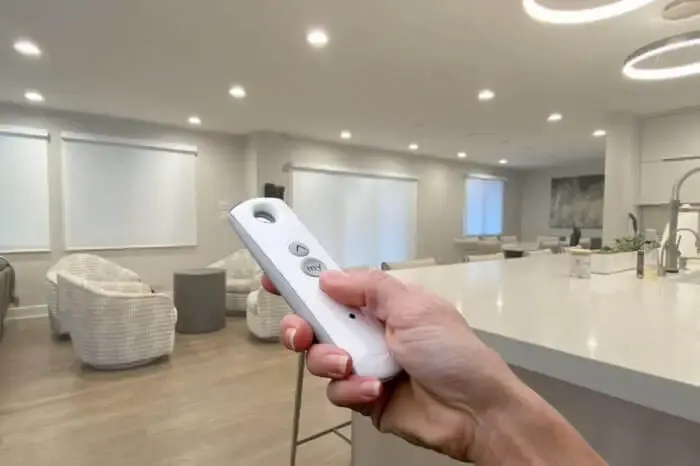
Ask five different people what "smart shades" means and you will get five different answers, a remote, an app, a voice command, a schedule, a scene that runs the whole house. All of it runs through the same handful of components, and understanding those components makes the whole shopping process a lot less confusing.
How Motorized Shades Actually Work
Think of a motorized shade as two separate systems stacked together: the shade itself, which is mechanical, and the smart layer, which is a hub and an app sitting on top of it. You can have a beautifully built shade with a great motor and skip the smart layer entirely if all you want is a remote on the coffee table.
Homeowners doing a whole-house project in Carmel usually want every shade on one app, grouped by room, so morning light comes into the kitchen while the bedroom stays dark. That grouping lives in the hub, not in the individual shades, so planning which rooms get grouped together is worth doing before the order goes in.
A newer standard called Matter is meant to let smart devices talk across ecosystems more easily, and some shade hubs are starting to support it, but most motorized shade systems today still lean on their own hub and app as the center of the setup.
Voice Control and the Hub Question
Budget for the hub, not just the shades, if voice control matters to you. Most manufacturer hubs are a one-time purchase that can then handle quite a few shades, so the cost per window drops fast once you're past the first one or two.
Where costs sneak up: mixing brands. If a Carmel homeowner already owns shades from one manufacturer and adds a different brand later, expecting them to share one app, that often needs a second hub, sometimes a separate app entirely. Checking ecosystem compatibility before adding on to an existing system saves a second purchase down the road.
Voice assistant compatibility itself is usually free to the homeowner, in the sense that the platform doesn't charge extra for it, but getting a specific hub approved to talk to a specific voice platform is the manufacturer's decision, not something you can add yourself if the hub doesn't already support it.
Power Planning and Backup Control
If hardwired power is the plan, figure that out before drywall goes up, not after. Running a low-voltage line behind the wall to a discreet plug point during a remodel or new build is straightforward. Doing the same thing in a finished Carmel home means fishing wire through existing walls and patching drywall afterward, which is a bigger job.
For an existing home where opening walls isn't realistic, a plug-in power adapter tucked behind furniture or drapery is usually the practical compromise, giving you the reliability of hardwired power without the construction.
Whichever power source you land on, keep at least one physical remote in the house that talks directly to the motor, not through the hub. App and voice control both depend on your network staying up, and a remote that bypasses all of that still works when Wi-Fi doesn't.
Weighing battery against hardwired, or one ecosystem against another, is easier with actual product in hand rather than a spec sheet. A free in-home measure lets you see and hear a motor running before you commit to a whole-house system.
What Actually Fails in a Smart Shade System
Ask what happens to the system during a power outage, specifically whether the hub reconnects automatically once power is restored or needs to be manually re-paired. Some manufacturers have handled this better than others, and it's a fair question to ask before buying into a particular ecosystem.
Ask how the hub performs at a distance from the router, and whether a range extender or a second hub is available if a Carmel home is larger or has a layout with a lot of walls between rooms and multiple floors.
And ask what a typical service call looks like when something goes wrong. A company that mostly deals with dead batteries and Wi-Fi hiccups is telling you something different than one that's constantly swapping out failed motors, and that difference says a lot about how the system was set up in the first place.
Battery Life and Charging in the Real World
The most common "my smart shade stopped working" call turns out to be a dead battery, not a broken motor or a network problem. The shade responds slowly, then not at all, and it looks like a bigger issue than it actually is.
Cold rooms make this worse and confuse the diagnosis further. A shade that's been fine all summer can start acting sluggish once a Carmel winter sets in, simply because cold temperatures reduce how much power a lithium battery can deliver at once, not because anything broke.
We've also seen solar panels mounted in the wrong spot, behind a curtain or tucked under an eave where it never actually sees direct sun, which defeats the purpose entirely. A solar add-on only helps if it's getting hit by real sunlight for a meaningful part of the day.
Frequently Asked Questions
Can I mix shade brands on one app?
Sometimes, but do not assume it. Different manufacturers often use different hubs and different radio protocols, so a shade from one brand may not show up in another brand's app without an additional bridge, if that is even available. Checking compatibility before adding a second brand to an existing system saves a headache later.
What actually causes a smart shade to stop responding?
More often than not, it is the network, not the shade. A hub that lost its Wi-Fi connection or a battery that quietly ran down are the most common causes we see, along with a router password that changed without the hub being updated. Actual motor failure is much less common and usually only shows up after years of heavy use.
Is Matter going to make all of this simpler?
Eventually, for some systems. Matter is a newer standard meant to let smart devices work across ecosystems without as much brand-specific bridging, and some newer shade hubs are starting to support it. Plenty of shades already installed do not support it yet and still rely on their original manufacturer hub, so it is not a universal fix as of 2008.
 Repair or Replace Your Carmel Blinds: How to Decide
 Do You Need Blackout, or Will Room Darkening Get the Job Done